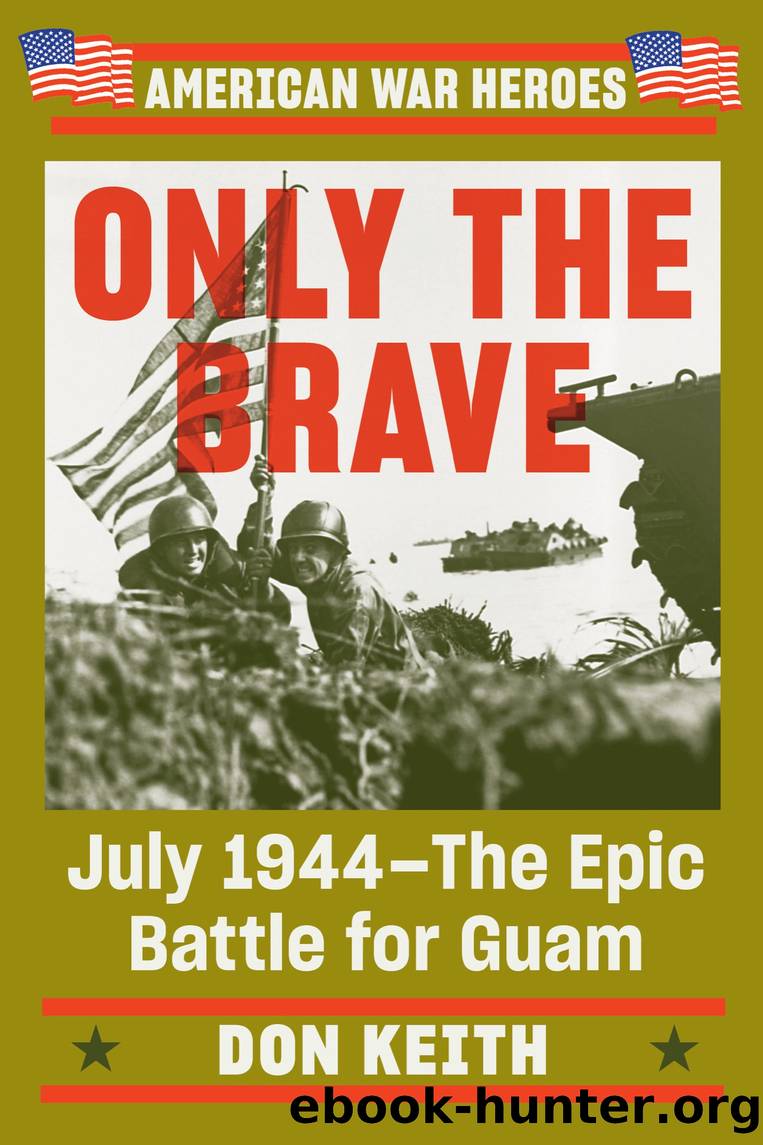
Only the Brave by Don Keith
Author:Don Keith [Keith, Don]
Language: eng
Format: epub
Publisher: Penguin Publishing Group
Published: 2021-06-29T00:00:00+00:00
â CHAPTER SEVEN â
H-HOUR
On July 21, 1944, the Battle of Guamâto be accurate, the second one of World War IIâwas finally underway. This time, however, the fight was initiated by the United States of America to reclaim its own lost territory. At 0808, the amtracs designated to be the first wave of the 3rd Marine Division pulled away from the big group of circling LVTs and formed a well-spaced lineup 2,000 yards wide. Then they began to move toward the 2,500-yard-wide bit of crescent-shaped beach between Asan and Adelup Pointsâthe ânorthern beachesââlocated less than three miles west of Agaña, the islandâs most populous town. As part of the assault, the LVTs were accompanied by landing craft infantry, gunboatsâLCI(G)sâeach carrying about two hundred troops and armed with 4.5-inch rocket launchers.
The Asan beaches had been divided into color-coded sectors, left to right from the landing forceâs perspective, designated âRed 1,â âRed 2,â âGreen,â and âBlue.â Each assault vehicle aimed for that segment of sand to which it had been assigned. The LCI(G)s headed for the flanks, aiming rockets at any point from which enemy fire seemed to emanate.
The bombardment from the naval vessels continued until the first amtracs and amphibious tanks were within 1,200 yards of the beaches. Then their aim switched so fire could be directed farther inland. The men could hear the ordnance from their support vessels screaming overhead as they moved toward their landing zones. At about the same time, scores of carrier-based fighter-bombers and over a dozen torpedo bombers made their final runs up and down the shoreline before shifting their attention as well to targets farther inland.
In addition to the duration and intensity of the pre-landing barrage, there was one other major difference in the Guam attack from previous beach assaults against Japanese-held territories. Other than the work of the frogmen blowing holes in coral northeast of Agaña, there was no attempt to fake a landing elsewhere to try to divert enemy attention and assets. Such tactics had been of little success in the past. Also, the logical landing sites on Guam were limited and obvious to everyone involved on both sides. It was hoped that the unusually large distance between the two actual assault points would be confusing enough to the Japanese that they would divide their attention and resources. Most of the previous Allied incursions in the Pacific had been against small atolls, often containing little more than an airfield, dug-in troop positions, and protective gun emplacements. Guam was much bigger, and the high mountains would be a challenge, especially in the early stages of the landing. From those highlands, the IJA could direct a variety of fire at the approaching amphibious craft, then troops on the shore, and eventually other motorized equipment and supply dumps. It was crucial the LVTs and LCI(G)s made it quickly through the reefs to the beaches and advanced promptly, disrupting those defenses.
Just before 0830, the first Marines had accomplished that first goal. They were on Guam at Asan. Meanwhile,
Download
This site does not store any files on its server. We only index and link to content provided by other sites. Please contact the content providers to delete copyright contents if any and email us, we'll remove relevant links or contents immediately.
The Vikings: Conquering England, France, and Ireland by Wernick Robert(84524)
Ali Pasha, Lion of Ioannina by Eugenia Russell & Eugenia Russell(40374)
The Conquerors (The Winning of America Series Book 3) by Eckert Allan W(38675)
The Vikings: Discoverers of a New World by Wernick Robert(37043)
Cecilia; Or, Memoirs of an Heiress — Volume 1 by Fanny Burney(32708)
Cecilia; Or, Memoirs of an Heiress — Volume 2 by Fanny Burney(32072)
Cecilia; Or, Memoirs of an Heiress — Volume 3 by Fanny Burney(32053)
Empire of the Sikhs by Patwant Singh(23180)
The Secret History by Donna Tartt(19436)
Hans Sturm: A Soldier's Odyssey on the Eastern Front by Gordon Williamson(18705)
Cat's cradle by Kurt Vonnegut(15524)
Pimp by Iceberg Slim(14774)
Sapiens: A Brief History of Humankind by Yuval Noah Harari(14535)
Norse Mythology by Gaiman Neil(13536)
Talking to Strangers by Malcolm Gladwell(13515)
Leonardo da Vinci by Walter Isaacson(13471)
4 3 2 1: A Novel by Paul Auster(12596)
Underground: A Human History of the Worlds Beneath Our Feet by Will Hunt(12216)
The Radium Girls by Kate Moore(12164)
